ISSN 1884-0760
GRACE TECHNICAL REPORTS
Supporting Feature Model Refinement
with Updatable View
Bo WANG Zhenjiang HU Qiang SUN Haiyan ZHAO
Yingfei XIONG Hone MEI
GRACE-TR 2010–05 May 2010
CENTER FOR GLOBAL RESEARCH IN
Supporting Feature Model Refinement
with Updatable View
Bo WANG1
Zhenjiang HU2
Qiang SUN3
Haiyan ZHAO1
Yingfei XIONG4
Hong MEI1
1
Key Laboratory of High Confidence Software Technologies, Peking University, China
{wangbo07,zhhy, meih}@sei.pku.edu.cn
2
GRACE Center, National Institute of Informatics, Japan
Department of Computer Science Shanghai Jiao Tong University, China
Generative Software Development Lab The University of Waterloo, Canada
Abstract
In the research of software reuse, feature models have been widely adopted to capture, organize and reuse the requirements of a set of similar applications in a software domain. However, the construction, especially the refinement, of feature models is a labor-intensive process, and there lacks an effective way to aid domain engineers in refining feature models. In this paper, we propose a new approach to supporting interactive refinement of feature mod-els based on the view updating technique. The basic idea of our approach is to first extract features and relationships of interest from a possibly large and complicated feature model, then organize them into a comprehensible view, and finally refine the feature model through modifications on the view. The main characteristics of this approach are two folds: a set of powerful rules (as the slicing criterion) to slice the feature model into a view automatically, and a novel use of a bidirectional transformation language to make the view updatable. We have successfully developed a tool, and a nontrivial case study shows the feasibility of this approach.
1
Introduction
important step of constructing a feature model is to refine a big, abstract feature into small, concrete features. Different approaches have been proposed to guide the refinement of features. For example, in FODA [1], a set of guiding principles are proposed to refine feature models. In FORM [2], features are refined in four layers according to the feature hierarchy, i.e. capabilities, operating environments, domain technologies and implementation techniques.
Feature models grow large during refinement. Reports [4][5][6] show that real-would feature models often grow beyond thousands of features, and the largest one reported [7] has more than 5000 features. On the other hand, feature model re-finement becomes more and more difficult when the feature model grows. For one thing, it becomes more difficult to find all features related to the current refinement task. For another, it is difficult to locate a specific feature in the large model.
One way to attack this problem is to organize features related to the current refinement task into a view. Then the domain engineer only modifies the view to accomplish the current refinement task. As the view is usually much smaller than the whole feature model, the refinement task becomes much easier. However, there are several challenges in applying this idea. First, it is difficult to locate all related features that should be contained in the view. Second, it is unknown how to organize these features into a view so that their relations and hierarchical information are preserved. Third, it is unclear how to reflect the modification on the view back into the feature model.
In this paper, we propose a new approach to supporting interactive refinement of feature models based on the above idea. In our approach, first, domain engi-neers choose features of interest (called initial features); second, a set of features and relationships that may help domain engineers refine the feature model are auto-matically extracted from the feature model, with the help of eight heuristic slicing rules; third, all the extracted features and relationships are automatically organized into an annotated feature model (called view); and finally, after domain engineers refine the view, we transform all view updates into updates on the feature model by using the bidirectional transformation technique [8]. The main contributions of our paper are summarized as follows:
• We have made the first attempt of applying theslicingtechnical to feature
model refinement, by proposing a set of slicing rules to extract related fea-tures and relationships based on initial feafea-tures, and giving an organizing algorithm to organize them into a view that is comprehensible enough for later refinement.
• We define a set of valid modifications on the view and apply the
bidirec-tional transformation technique in building theupdatable view, so that any
• We implement a tool1 and successfully apply it to refine the web store do-main, which shows that our approach to feature model refinement via modi-fication on sliced view is promising and potentially useful in practice.
The rest of this paper is organized as follows. Section 2 gives some prelimi-nary knowledge on feature models. Section 3 introduces a running example that will be used through the paper. Sections 4, 5 and 6 amplify the whole process of our approach. Section 7 illustrates our approach with the web store system case study. Section 8 discusses the related work, and Section 9 concludes the paper and highlights the future work.
2
Preliminary: Feature Models
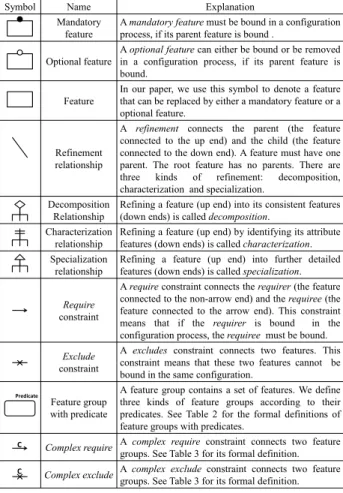
There currently exist several notations for describing feature model [1][3][9]. In our approach, we adopt, though not limited to, the notation proposed by Zhang et al.’s work [9]. The basic notations and their semantics are summarized in Table 1.
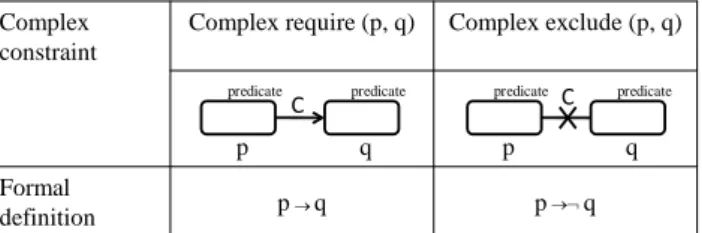
Feature groups with predicates are explained more in Table 2. In this table, f1...fndenotes features. For a featuref, bind(f) is a predicate; it is true if f is bound, and false if unbound. And, complex constraints are shown in Table 3. In
this table,pandqdenote feature groups with predicates.
3
A Running Example
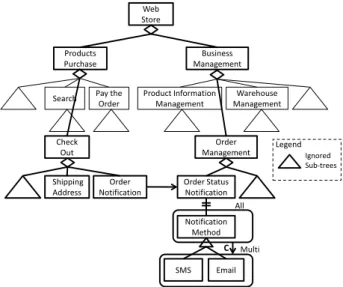
We use the web store domain as a running example to demonstrate our approach. A web store is an online shop that sells products or services. In the past few years, more and more consumers choose web stores to purchase products or services. Web store systems are composed of two parts, namely, the Products Purchase and the Business Management. In the Products Purchase, customers can register an ac-count, browse and choose products, check out, pay the order and ask for help when encountering problems. In the Business Management, the shop operators can pro-cess orders, manage warehouse, arrange advertisements, start products promotions and manage staffs of the web store. Figure 1 shows part of the web store feature model. This example is constructed according to a real world example [10] which will later be used to evaluate our approach.
It is usually not easy for domain engineers to refine large feature models. For
example, if a domain engineer wants to refine featureShipping Address, he needs
to find out the features related to it and analyze these features to find any hints for this refinement task. It is difficult for the domain engineer to do it manually in this large feature model. In this paper, we will demonstrate how our approach helps domain engineers collect and organize related parts in the feature model to help domain analysts refine the feature model.
1
Table 1: Symbols and Explanations for Feature Models
Symbol Name Explanation Mandatory
feature
Amandatory featuremust be bound in a configuration process, if its parent feature is bound .
Optional feature
Aoptional featurecan either be bound or be removed in a configuration process, if its parent feature is bound.
Feature
In our paper, we use this symbol to denote a feature that can be replaced by either a mandatory feature or a optional feature.
Refinement relationship
A refinement connects the parent (the feature
connected to the up end) and the child (the feature connected to the down end). A feature must have one parent. The root feature has no parents. There are three kinds of refinement: decomposition, characterization and specialization.
Decomposition Relationship
Refining a feature (up end) into its consistent features (down ends) is calleddecomposition.
Characterization relationship
Refining a feature (up end) by identifying its attribute features (down ends) is calledcharacterization. Specialization
relationship
Refining a feature (up end) into further detailed features (down ends) is calledspecialization.
Require
constraint
Arequireconstraint connects therequirer(the feature connected to the non-arrow end) and therequiree(the feature connected to the arrow end). This constraint means that if the requirer is bound in the configuration process, therequiree must be bound.
Exclude
constraint
A excludesconstraint connects two features. This constraint means that these two features cannot be bound in the same configuration.
Feature group with predicate
A feature group contains a set of features. We define three kinds of feature groups according to their predicates. See Table 2 for the formal definitions of feature groups with predicates.
Complex require Acomplex require constraint connects two feature
groups. See Table 3 for its formal definition.
Complex exclude Acomplex excludeconstraint connects two feature
groups. See Table 3 for its formal definition.
Predicate
C
C
4
Approach Overview
Our approach is composed of two parts, 1) build an updatable view with feature model slicing, and 2) refine the feature model with an updatable view, as shown in Figure 2. We will introduce the two parts in details in Section 5 and Section 6, respectively. In this section we first give an overview of the approach.
Table 2: Feature Groups with Predicates
Feature group with predicate
Multi Single All
Formal definition
bind(f1) bind(f2) … bind(fn)
bind(f1) bind(f2) … bind(fn)
bind(f1) bind(f2) … bind(fn) f1,f2,…,fn
Multi
f1,f2,…,fn
Single
f1,f2,…,fn
All
∪
∪ ∪ ⊗⊗ ⊗
∩ ∩ ∩
Table 3: Complex Constraints
Complex constraint
Complex require (p, q) Complex exclude (p, q)
Formal
definition p q p q
predicate
p
predicate
q
predicate
p
predicate
q
→ →¬
C C
In the second part, domain engineers refine the original feature model by ex-amining and modifying the view. We define a set of valid operations on the view and how these operations correspond to operations on the original feature model. With these valid operations, domain engineers can modify the view and all the modifications can be automatically reflected on the original feature model. We ap-ply the bidirectional transformation technique to implement the reflection of view modifications.
As an example, let us see how our approach helps refine featureShipping
Ad-dress in Figure 1. First, the domain engineer selects initial features of interest. Since a shipping address is used to deliver an order, we suppose the domain
en-gineer selects features Shipping Address and Order Status Notificationas initial
features. Then related features are automatically extracted to form a
comprehensi-ble view. In this case, the generated view containsShipping Addressand sub-trees
ofOrder Status Notification. Then the domain engineer only inspects this view
and founds thatShipping Addressmust has a child featureMobile Numberbecause
there is featureSMS, which means that the system can notify the customer of the
order status by sending messages to his mobile phone. So he added feature
Mo-bile Numberas a child feature ofShipping Addresson the view, and the feature is
also automatically added to the original feature model as a sub feature ofShipping
Order Notification
Order Status Notification Web
Store
Products Purchase
Business Management
Check Out
Shipping Address
Order Management
SMS Email
Notification Method
0 0
Search Product Information
Management Pay the
Order
Warehouse Management
0 0
All
Multi
00
Legend Ignored Sub-trees
C
Figure 1: A Simple Web Store Feature Model
Feature Model
Refine the Feature Model with View
Updating Refined
Feature Model
Legend Artifact
Manual Activity Part 2
Comprehensible View
Part 1
Select Initial Features
Extract Features and Relationships
Organize Features and Relationships
Automatic Activity
Figure 2: Overview of our Approach
5
Build a Comprehensible View with Feature Model
Slic-ing
In this section, we introduce the first part of our approach, in which features and relationships are extracted from the feature model and organized into a compre-hensible view to help domain engineers refine the feature model.
The idea of feature model slicing is inspired by the concept of program slicing. Program slicing [11] takes a program and a slicing criterion as inputs, and returns a sub set of the program that satisfy the criterion.
5.1 Preprocess: select initial features
To obtain the view, domain engineers are requested to select initial features that they want to focus on. The domain engineer may want to refine these initial fea-tures, or they may want to use these features to help refine other features. It is worthwhile to note that although it is a free selection process, the initial features have an influence on the generated view because the slicing rules use these initial features as starting points to extract related features and relationships. Therefore, whether the view can greatly benefit the process of refinement depends on the ini-tial features.
5.2 Extract related features and relationships
Based on the initial features, some closely related features and relationships are extracted from the feature model. These features and relationships can help domain engineers refine the feature model.
Eight heuristic slicing rules are provided to identify features and relationships closely related to the initial features. These rules are categorized into two types, namely the Feature Identification Rules and the Relationship Identification Rules.
Feature Identification Rules
The goal of feature identification rules is to identify features closely-related to
the initial features. We call these featuresextended features. The slicing rules for
identifying extended features are listed as follows.
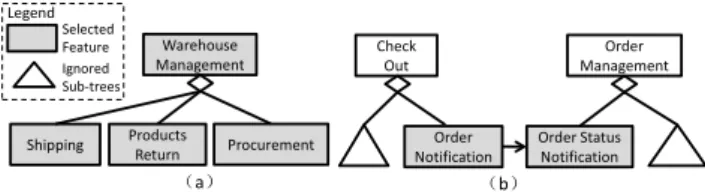
F1:Identify extended features by finding offspring of the initial features. The offspring of a feature characterize their parent in detail and contain vari-able points related to the parent. If a domain engineer focuses on one feature, he should also consider the offspring of the feature when refining the feature model.
For example, if featureWarehouse Management is selected as an initial feature,
the domain engineer should also consider featureShipping,Products Return, and
Procurement, as shown in Figure 3(a).
F2:Identify extended features by finding parents of the initial features. A parent feature describes its children in a higher abstraction level and the parent feature helps domain engineers understand the feature model. If a domain engineer focuses on all the children of a feature, he should also consider the parent
of these children when refining the feature model. In Figure 3(b), featureShipping
Method, Shipping Address, Payment Method andOrder Notification are selected
as initial features. The parent featureCheck Outof these initial features can help
Shipping Products
Return Procurement
Warehouse Management
O
√
O O Shipping
Method
Payment Method
Order Notification Check
Out
Shipping Address
√
O 00
Legend Extended Feature Initial Feature O
√
(a) (b)
√ √ √
Figure 3: Examples of Rules F1 and F2
Payment Method
Pay the Order
Currency Type
Shipping Method
UPS EMS FedEx
00 Legend
Extended Feature Initial Feature
O
√
(a) (b)
O O
√ √ O
Post
O
Figure 4: Examples of Rules F3 and F4
characterization relationship, the domain engineer should also consider all its char-acterization siblings when refining the feature model.
For example, the feature Pay the Orderis characterized by two attribute
fea-tures,Payment MethodandCurrency Type, as shown in Figure 4(a). If featurePay
Methodis selected as an initial feature, the domain engineer should also consider Currency Type.
F4:Identify extended features by finding specialization relationships.
In a specialization relationship, siblings describe different ways of implement-ing their parent. If a domain engineer focuses on one of the children in the special-ization relationship, the domain engineer should also consider all its specialspecial-ization siblings when refining the feature model.
For example, featureShipping Method is specialized into feature UPS,EMS,
FexEx, andPost, as shown in Figure 4(b). If featureUPSis selected as an initial feature, the domain engineer should also consider the other three features.
Relationships Identification Rule
Generally speaking, all the relationships among the selected features (initial features and extended features) should be extracted, because these relationships help domain engineers understand and refine the feature model. It is worth noting that a constraint is a kind of relationship. A feature group is also a kind of relation-ship, because each feature group has a predicate on its members. In the following we explain each type of relationship in details.
R1:Identify refinement relationships between the selected features.
If all features in a refinement relationship are selected, the domain engineer should also consider the refinement relationships when refining the feature model.
fea-Order Notification
Order Status Notification
(b) Check
Out
Order Management
0 0
00 Legend
Selected Feature Ignored Sub-trees
Shipping Products
Return Procurement
Warehouse Management
(a)
Figure 5: Examples of Rules R1 and R2
SMS Email Notification
Method
Multi All
00
Legend
Selected Feature
C
Feature-Group p Feature-Group q
Figure 6: Examples of Rules R3 and R4
tures: Shipping,Products Return, andProcurement, as shown in Figure 5(a).
Do-main engineers should also consider this decomposition relationship. R2:Identify binary constraints between the selected features.
If both features of a binary constraint (require constraint or exclude constraint) are selected, the domain engineer should also consider the binary constraint when refining the feature model.
For example,Order NotificationandOrder Status Notificationare selected, and
there is a require constraint between them. Domain engineers should also consider this require constraint.
R3:Identify feature group predicates among the selected features.
If all features of a feature group are selected, the domain engineer should also consider the feature group predicates when refining the feature model.
For example,SMSandEmailare selected, as shown in Figure 6; domain
engi-neers should also consider the feature group that has a Multi predicate on them.
R4:Identify complex constraints among feature groups.
If both feature groups of a complex constraint are included in the slicing, the domain engineer should also consider the complex constraints when refining the feature model.
For example, there are two feature groupspandqin Figure 6. Groupphas one
feature Notification Method and predicate All. Group q has feature SMS, Email
and predicateMulti. When feature groupspandqare selected, domain engineers
should also consider the complex requires betweenpandq.
5.3 Organize the features and relationships into a view
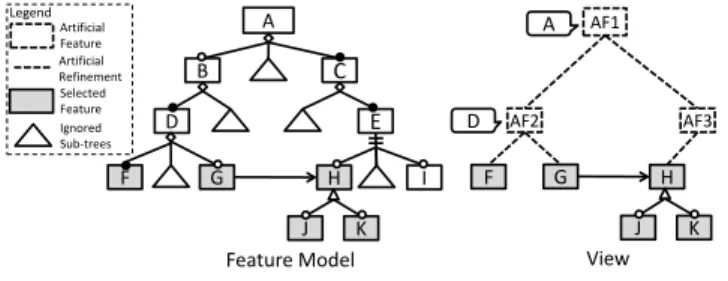
According to rules R1 and R2, the selected features are a set of sub-trees from the original feature model. Usually these sub trees are scattered in the model, which make the results of the extraction hard to understand. For example, there are 5 selected features in the feature model, as indicated by the grey rectangles in Figure 7. These 5 features are in three sub-trees locates in different parts of the feature model.
In our approach, we organize the results of the extraction by computing the lowest common ancestor (LCA) of the roots of the sub-trees. For any two features, their LCA is their shared ancestor that is located farthest from the root feature. With LCAs, artificial features, annotations and artificial relationships are created to organize the results of the extraction.
For each LCA, an artificial feature is created and attached with an annotation which indicates the source of the artificial feature. For example, the LCA of fea-tureFandGis featureD. In the view, artificial featureAF2is created as the parent
feature ofFandG. This artificial feature is attached with an annotation which
in-dicates that it can be traced to featureDin the original feature model, as shown in
Figure 7. After we create an artificial feature, we create two artificial refinement relationships from the artificial feature to the roots of the two sub-trees, respec-tively. In this way we make the artificial feature the common parent of the two sub trees.
A
B C
D
G
F H I
E
J K
AF1
AF2
G
F H
J K
AF3 D
A
00 Legend
Artificial Feature
Selected Feature Ignored Sub-trees Artificial Refinement
Feature Model View
Figure 7: An Example of Constructing a View
Besides adding artificial features for LCAs, our approach also adds artificial
features to keep the relative depth of each feature. For example, featureFandH
have the same depth of 4 in the original feature model. After addingAF2andAF1
as common features, featureFhas a depth of 3 and featureHhas a depth of 2, and
they are not of the same depth. So we add another artificial feature,AF3, to make
FandHhave the same depth.
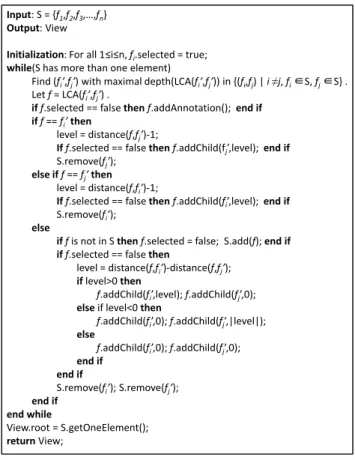
The view is built by an organizing algorithm that adopts a bottom up tree con-struction strategy, as illustrated in Figure 8. This algorithm takes the roots of the sub-trees as inputs and builds the view as output.
This algorithm 1) finds the LCA for each feature pair(f′
i, fj′)in the input setS, 2) picks the LCA of these two features, 3) generates an annotated artificial feature
for the picked LCA if it is are not in the set S, 4) adds the artificial refinement
relationships from this LCA to the featuresf′
Input: S = {f1,f2,f3,…,fn}
Output: View
Initialization: For all 1≤i≤n, fi.selected = true;
while(S has more than one element)
Find (fi’,fj’) with maximal depth(LCA(fi’,fj’)) in {(fi,fj) |i≠j, fi∈S, fj∈S} .
Letf = LCA(fi’,fj’) .
iff.selected == false thenf.addAnnotation(); end if iff== fi’then
level = distance(f,fj’)-1;
Iff.selected == false thenf.addChild(fj’,level); end if S.remove(fj’);
else iff == fj’then level = distance(f,fi’)-1;
Iff.selected == false thenf.addChild(fi’,level); end if S.remove(fi’);
else
iffis not in S thenf.selected = false; S.add(f); end if iff.selected == false then
level = distance(f,fi’)-distance(f,fj’);
iflevel>0 then
f.addChild(fi’,level); f.addChild(fj’,0);
elseif level<0 then
f.addChild(fi’,0); f.addChild(fj’,|level|);
else
f.addChild(fi’,0); f.addChild(fj’,0);
end if end if
S.remove(fi’); S.remove(fj’);
end if end while
View.root = S.getOneElement(); return View;
Figure 8: An Algorithm for Constructing a View
f′
i andfj′ from the setSand adds the LCA into the setS. The procedure is iterated until the whole view is built. The key variables and functions are illustrated as follows:
• Each feature has an attributeselectedthat manifests whether it is in the input
set;
• FunctionLCA(fi′, fj′)computes the LCA offi′andfj′;
• Functionf.addChild(f′
i, level)generates the artificial refinement
relation-ships fromf tofi′ by adding the number of level artificial features between
them to keep their relative hierarchy. If the parameter level is equal to 0,f′ i becomes a child of f;
• Functiondepth(f)returns the distance from the root feature to featuref;
• Functiondistance(f, fj′)computes the length of the path fromf tofj′.
6
Refine Feature Models with Updatable Views
In this section, we first define the updatable view; then prove that the updatable view can be built by the GRoundTram system.
6.1 Refine feature models with view updating
The updatable view is defined by a view and a set of valid operations on it. Domain engineers can refine the feature model by using these valid operations to modify the view. These modifications on the view can be automatically reflected back to the original feature model.
In order to clarify the valid operations on view, we will introduce both the valid operations and the invalid operations. The valid operations are provided to facilitate the feature model refinement. And the invalid operations have little contribution to the feature model refinement.
We classify the operations on the view into three categories: add,delete, and
change. Domain engineers can add or delete features and relationships. They can also change the attributes of features and relationships.
Invalid Operations
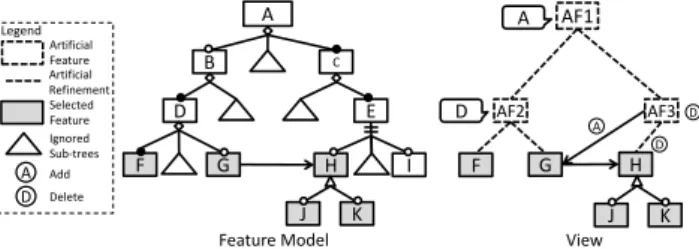
1) Add relationships: If the operation of adding relationship involves artificial features, it is invalid. Adding relationships that contains artificial features cannot help refine the feature model, because artificial features are created only for
orga-nizing. For example, adding a require constraint between artificial featureAF1and
featureGis meaningless.
2) Delete features and relationships: If the deleting operation refers to artificial features and relationships, it is invalid. For example, in the updatable view shown
in Figure 9, deleting artificial featureAF3and the artificial relationship between
AF3andHwill make the view hard to understand and cannot help refine the feature
model.
AF1
AF2
G
F H
J K
AF3
D A
A D
D 00
Legend Artificial Feature
Selected Feature Ignored Sub-trees A Add D Delete
A
B C
D
G
F H I
E
J K
Feature Model View
Artificial Refinement
Figure 9: Examples of Invalid Operations
Valid Operations
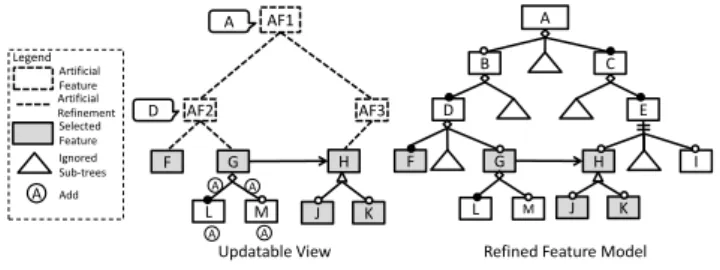
the selected parent in the view, it is valid. If the relationships that only contain the selected features, the operation of adding them is valid. Figure 10 shows how
A
B C
D
G
F H I
E J K AF1 AF2 G F H J K AF3 D A A L M A A A L M 00 Legend Artificial Feature Selected Feature Ignored Sub-trees A Add
Updatable View Refined Feature Model Artificial
Refinement
Figure 10: Example of Adding Features and Relationships
the added features and relationships are transformed back to the original feature
model. For example, featureLandMare added as the children of featureGwith a
decomposition relationship in the view. All these modifications are reflected in the refined feature model.
2) Delete features and relationships: If the features are not artificial in the view, the operation of deleting them is valid. If a feature is deleted, all its children are deleted automatically. All the constraints and relationships on the deleted features are also deleted. If the relationships only contain the selected features, the opera-tion of deleting them is valid.
A
B C
D
G
F H I
E J G F H J K D A D D 00 Legend Artificial Feature Selected Feature Ignored Sub-trees Delete D
Updatable View Refined Feature Model Artificial
Refinement
Figure 11: Examples of Deleting Features and Relationships
Figure 11 shows how the deletion of features and relationships are reflected
back to the original feature model. For example, featureL and the require
con-straint betweenGandH are deleted in the view. All these modifications are
re-flected in the refined feature model.
3) Change attributes of features and relationships: If the attributes belong to the selected features and relationships, the operations of changing them is valid.
In general, domain engineers can modify any feature and relationship that exist in the original feature model. However, the artificial features and relationships which are introduced to organize and enrich the view cannot be modified, because modifying these features and relationship cannot help refine the feature model.
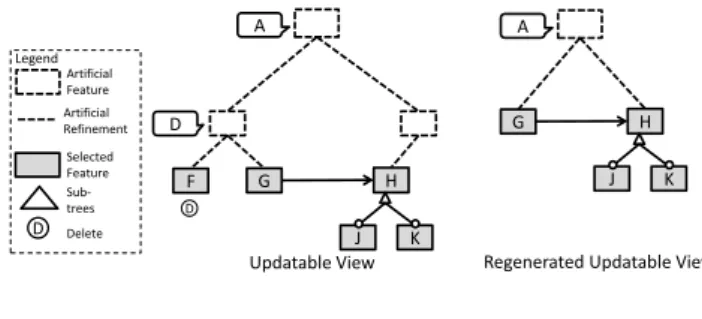
the sub-trees are deleted in the view, the content and the structure of the artificial features may be changed, because the deletion of the roots may lead to the change of the LCA. In this case, the view needs to be built again after the deletion is reflected back to the original feature model.
For example, if feature F is deleted in the view, the featureF in the original
feature model (see Figure 7 feature model) is also deleted. Then in the original
fea-ture model, feafea-tureDis no longer a LCA. So we have to regenerate the updatable
view, as shown in Figure 12.
G
F H
J K D
A
D
G H
J K A
00
Legend
Artificial Feature
Selected Feature Sub-trees
Delete
D
Updatable View Regenerated Updatable View
Artificial Refinement
Figure 12: An Example of Deleting the Root of a Sub-tree
It is worth noting that any operation on the original source feature model cor-responds to a valid operation on one of its sliced views.
6.2 Use bidirectional transformation to build updatable views
In the previous section we have seen the definition of updatable view. In this sec-tion we discuss how bidirecsec-tional transformasec-tion techniques can be used for easy implementation of an updatable view.
We use the system GRoundTram [12][13], which has been developed to sup-port systematic development of bidirectional model transformation. GRoundTram adapts an existing well established graph querying language UnQL [14] for model transformation. It provides a powerful bidirectional transformation language UnQL+ that extends UnQL and performs an efficient bidirectional computation. In GRound-Tram, graphs are edged-labeled in the sense that all information is stored as labels on edges rather than on nodes. The GRoundTram system gives a support to con-struct an updatable view, maintaining the traceability between the feature model and the updatable view.
We represent, in GRoundTram, a feature model by a source graph model2, and
an updatable view by a target graph model. A forward UnQL+ query is
automati-callycreated by analyzing the result of feature model slicing. Once a forward query is provided, the backward transformation comes for free by the GRoundTram sys-tem. In this way we only need to implement a forward query that extracts a view
Add
cash
Trace
submitorder
Delete
account
Figure 13: Snapshot of GRoundTram System
from the feature model, and do not have to write code to reflect the updates back into the source.
Besides the easy implementation of the updatable view, another two advan-tages of using GRoundTram in our approach is that: 1) GRoundTram maintains the history of the modifications caused by backward transformation, so that we can easily implement an undo functionality to cancel a refinement; 2) GRoundTram records the traceability links between nodes in the source graph and nodes in the target graph, so that we can easily support tracing back from features on the view back to the features in the original model. For example, Figure 13 shows a snap-shot of GRoundTram system, the source graph model and target graph model are displayed in the left and right part, respectively. Suppose that in the target graph
model, we first delete the featureaccountand perform the backward
transforma-tion. And then, we add the featurecashand perform the backward transformation
again. History of these changes is reflected to the source graph model (left in Fig-ure 13). In this modified source graph model, the featFig-ure deleted is represented by a set of dash nodes and edges and the feature added is colored with purple. In
addition, when we select the feature submitorder on the target graph model, the
selected feature can be traced back to the source graph model with red highlight.
6.3 Reflect the refinement on views to feature models
Now we show that GRoundTram is a powerful bidirectional transformation system which makes all the refinement on views be truly reflected to the original feature model. There are two facts about GRoundTram [12][13].
Fact 2.All the basic graph operations on the projection view of a graph model can be transformed back. These basic operations are: 1) adding/deleting nodes, 2) adding/deleting edges and 3) relabeling edges.
First, we explain that it is feasible to use UnQL+ provided by GRoundTram to implement the feature model slicing. We define some concepts to describe the view
formally. F is a feature set and R is a set of relationships overF. Relationship
r(r ∈ R) can be represented as{(f1, f2)|(f1, f2) ∈ r, f1 ∈ F, f2 ∈ F}. The
union of the relationships in R is defined byU(R) = S
r∈R
r. Then, the transitive
closure can be defined as follows:
• Set0
(U R) =F0,
• Set1
(U R) ={f|(g, f)∈U R, g ∈Set1
(U R)},
• T C(U R) =Set(U R) = S
i≥0
Seti(U R).
Any part of the feature model can be characterized by a FO(TC) formula. Since the extracting features and relationships in the view can be traced back to the fea-ture model, they correspond to a part of the feafea-ture model. Therefore, they can be described by FO(TC) formula. The artificial features and relations of the view can be directly illustrated by FO formula. The whole view can be characterized by the FO(TC) formula. Fact 1 guarantees that the forward transformation (i.e., slicing) can be expressed in UnQL+ language.
Then, we show informally that all the valid operations on the view can be reflected backward to the feature model. The view and feature model in GRound-Tram are represented in the form of the target graph model and source graph model, respectively. Target graph model contains two kinds of elements, namely traceable elements and artificial elements. Artificial elements are the artificial nodes and edges. Traceable elements are the nodes and edges that can be traced back to the source graph model. Any valid operation on the view is decomposed into some basic graph operations on the traceable elements in the target graph model. Fact 2 guarantees that the valid operations on the view can be backward transformed to the feature model.
7
An example
Customer
Account Service Browse Search Customer Service User Behavior Track Product Information Management Advise ment Promo tion Staff Account Management Authority Management Shipping Method Payment Method Order Notification Method Examine Order Order Status Notification Order Return Close Order Products Return procurement
UPS EMS FedEx Web Store Products Purchase Business Management Check Out Shipping Address Pay the Order Order Management Warehouse Management Shipping Shipping Method
0 0 0 0 0
SMS Email Notification Method 00 Legend Extended Feature Initial Feature O √ √ √ √ √ √ √ √ √ √ Post O O O O O O O
√ O O O
O O Ignored Sub-trees All Multi C All Multi C Currency Type O
Figure 14: The Web Store Feature Model
This refinement task consists of three steps. First, initial features are selected to express what we may want to refine in the feature model. Then, other features and relationships that may help us to refine the feature model are automatically extracted and organized into an updatable view. Finally, we focus on generated view and modifies it. The modifications on the view are reflected on the original feature model automatically.
7.1 Select initial features
The selection of the initial features is to tell the system what we wants to consider in the process of refinement.
10 initial features are selected to indicates the concerns on the shopping- related parts of the feature model. These initial features are marked with a red hook on the top left corner of the feature, as shown in Figure 14.
7.2 Slice the feature model into an updatable view
Based on the initial features, features and relationships are automatically extracted from the feature model and organized into a view. We use the GRoundTram System to make the view updatable.
Shipping Method Payment Method Choose Notification Meth od Change Order Order Status Notification Cancel Order Close Order
UPS EMS FedEx Products Purchase Check Out Shipping Address Pay the
Order ManagementOrder
Shipping Shipping Method SMS Email Notification Method Legend Extended Feature Initial Feature O √ √ √ √ √ √ √ √ √ √ Post O O O O O O O
√ O O O
O O Ignored Sub-trees All Multi C All Multi C
Name Address Zip Code Mobile Phone
Member
Account Visa COD
A Add Show Account A A A A A
A A A
A A A A A A A Web Store Business Management A Artificial Feature Artificial Refinement C Change C C Currency Type O
Figure 15: The View of the Web Store Feature Model
7.3 Refine the view
The generated view collects the useful information to help us focus on parts of the original feature model. Then we can refine the feature model by performing the valid operations defined in Section 6 on the view.
Eight features and eight relationships are refined from existing features. Two features are changed in the view. Due to the limit of space, the result of the back-ward transformation on the feature model is not presented here.
During the refinement, three of eight added features are created with the help
of extracted features and relationships, as shown in Figure 15. FeaturesUPS,EMS
andFedEx remind us that if web stores support express delivery, it can supports
cash on delivery. So featureCODis added as a specialized feature of feature
Pay-ment Method. In addition, if a web store allow customers using a member account to pay an order, the system should show the balance of the member account when
customers checks out the order. So featureShow Account is created as the child
of featureChecks Out. FeatureSMSindicates that the system can notify the
sta-tus of the order by sending customers an instant message. The system should let
customers enter the phone number when they check out. Therefore, featureMobile
Numberis refined from featureShipping Addressfor this reason.
We can conclude from the example that the extracted and organized view help us in ways of collecting information and providing some hints to refine the feature model.
8
Related Work
The original concept of a program slice was introduced by Weiser [11]. Weiser defined a program slice as a reduced, executable program that is abstracted from the original program and can produce the specified subset of behavior of the original program. The task of computing program slices is called program slicing. Feature model slicing is inspired by the concept of program slicing. It can be defined by abstracting the meaningful parts from a feature model to form a view. Different from the program slicing, our slicing criterion focus on feature relations rather than program semantics. Besides, we also have an organization algorithm to organize the sliced feature. Kagdi et al. [15] propose UML model slicing. Their definition is general and their approach targets the UML model. Our approach is focused on the feature model.
View updating (bidirectional transformation) has been intensively studied in the database community [16][17][18][19][20]. Recently, a lot of work has been devoted to design of bidirectional languages for developing bidirectional transfor-mation, which has many applications [8] including synchronization of replicated data in different formats [21], presentation-oriented structured document develop-ment [22], and interactive user interface design [23], coupled software transforma-tion [24]. Our work is the first attempt of applying the bidirectransforma-tional transformatransforma-tion to the feature model refinement.
9
Conclusion
In this paper, we show the importance of slicing in feature model refinement, which has not be recognized so far. With the view updating technique, we are able to refine large and complicated feature models. The main features of our approach are two folds: a set of powerful slicing rules to slice the feature model into a view automatically, and a novel use of a bidirectional transformation language to make the view updatable. The updatable view allows domain engineers to refine feature models in an effective way; they can get the extracted and organized information, and refine the feature model by directly modifying the view. Our future work will focus on exploring more accurate slicing rules, working on more practical examples, and investigating applicability of our approach.
References
[1] K. C. Kang, S. G. Cohen, J. A. Hess, W. E. Novak, and A. S. Peterson, “Feature-oriented domain analysis (foda) feasibility study,” Carnegie-Mellon University Software Engineering Institute, Tech. Rep., November 1990.
[2] K. C. Kang, S. Kim, J. Lee, K. Kim, E. Shin, and M. Huh, “Form: A
feature-oriented reuse method with domain-specific reference architectures,” Ann.
[3] K. Czarnecki, S. Helsen, and U. W. Eisenecker, “Formalizing
cardinality-based feature models and their specialization,” Software Process:
Improve-ment and Practice, vol. 10, no. 1, pp. 7–29, 2005.
[4] D. S. Batory, D. Benavides, and A. R. Cort´es, “Automated analysis of feature
models: challenges ahead,”Commun. ACM, vol. 49, no. 12, pp. 45–47, 2006.
[5] F. Loesch and E. Ploedereder, “Optimization of variability in software
prod-uct lines,” inSPLC, 2007, pp. 151–162.
[6] M. Steger, C. Tischer, B. Boss, A. M¨uller, O. Pertler, W. Stolz, and S. Ferber, “Introducing pla at bosch gasoline systems: Experiences and practices,” in
SPLC, 2004, pp. 34–50.
[7] S. She, R. Lotufo, T. Berger, A. Wasowski, and K. Czarnecki, “The variability
model of the linux kernel,” inVaMoS, 2010, pp. 45–51.
[8] K. Czarnecki, J. N. Foster, Z. Hu, R. L¨ammel, A. Sch¨urr, and J. F. Ter-williger, “Bidirectional transformations: A cross-discipline perspective,” in
ICMT, 2009, pp. 260–283.
[9] W. Zhang, H. Mei, and H. Zhao, “Feature-driven requirement dependency
analysis and high-level software design,” Requir. Eng., vol. 11, no. 3, pp.
205–220, 2006.
[10] S. Q. Lau, “Domain analysis of e-commerce systems using feature-based model template,” MS in Applied Science, University of Waterloo, Depart-ment of Electrical and Computer Enginerring, 2006.
[11] M. Weiser, “Program slicing,” inICSE, 1981, pp. 439–449.
[12] S. Hidaka, Z. Hu, H. Kato, and K. Nakano, “Towards a compositional
ap-proach to model transformation for software development,” in SAC, 2009,
pp. 468–475.
[13] ——, “A compositional approach to bidirectional model transformation,” in
ICSE Companion, 2009, pp. 235–238.
[14] P. Buneman, M. F. Fernandez, and D. Suciu, “UnQL: A query language
and algebra for semistructured data based on structural recursion,”VLDB J.,
vol. 9, no. 1, pp. 76–110, 2000.
[15] H. H. Kagdi, J. I. Maletic, and A. Sutton, “Context-free slicing of uml class
models,” inICSM, 2005, pp. 635–638.
[16] F. Bancilhon and N. Spyratos, “Update semantics of relational views,”ACM
[17] U. Dayal and P. A. Bernstein, “On the correct translation of update operations
on relational views,”ACM Transactions on Database Systems, vol. 7, no. 3,
pp. 381–416, 1982.
[18] G. Gottlob, P. Paolini, and R. Zicari, “Properties and update semantics of
consistent views,” ACM Transactions on Database Systems, vol. 13, no. 4,
pp. 486–524, 1988.
[19] S. J. Hegner, “Foundations of canonical update support for closed database
views,” inICDT ’90: Proceedings of the Third International Conference on
Database Theory. London, UK: Springer-Verlag, 1990, pp. 422–436.
[20] J. Lechtenb¨orger and G. Vossen, “On the computation of relational view
com-plements,”ACM Transactions on Database Systems, vol. 28, no. 2, pp. 175–
208, 2003.
[21] J. N. Foster, M. B. Greenwald, J. T. Moore, B. C. Pierce, and A. Schmitt, “Combinators for bi-directional tree transformations: a linguistic approach to
the view update problem.” inPOPL ’05: ACM SIGPLAN–SIGACT
Sympo-sium on Principles of Programming Languages, 2005, pp. 233–246.
[22] Z. Hu, S.-C. Mu, and M. Takeichi, “A programmable editor for developing
structured documents based on bidirectional transformations,”Higher-Order
and Symbolic Computation, vol. 21, no. 1-2, pp. 89–118, 2008.
[23] L. Meertens, “Designing constraint maintainers for user interaction,” Jun. 1998, http://www.cwi.nl/ lambert.
[24] R. L¨ammel, “Coupled Software Transformations (Extended Abstract),” in
First International Workshop on Software Evolution Transformations, Nov.